My Journey in Human Development
I started my career as a preschool teacher.
But looking back now, I realize I didn't simply begin a career in early childhood education.
I began a lifelong journey in human development.
Before becoming an Early Childhood Educator, I completed a diploma in Child Psychology. I should have known then that understanding people—how we develop, what shapes us, what drives our behaviour, and what allows us to thrive—would become the thread running through my entire career.
From the beginning, I loved watching humans grow.
As a preschool teacher, that meant children.
Then I became a supervisor, and for seven years, I had the privilege of leading and developing adults too. I learned something very early in my leadership journey: when the adults feel safe, valued, and supported, children feel it too.
The wellbeing of one was never separate from the wellbeing of the other.
And families mattered just as deeply. I wanted them to walk through our doors knowing their heart was safe with us—that the little human who meant everything to them would be known, valued, and cared for.
Eventually, I became a Director, overseeing upwards of 28 locations.
It was there that I began to understand leadership on an entirely different scale.
I wasn't only influencing what happened in one classroom or one centre anymore. I had the opportunity to shape culture, leadership, and practice across an organization. I directly led a team of 13 supervisors, and my goal was never simply for them to do their jobs well. I wanted to create the conditions where people could thrive.
My understanding of leadership began to deepen.
It wasn't about having all the answers or being the person at the top. It was about what became possible for others because of how you led.
My own education evolved alongside my career.
I began a Bachelor's degree in Early Childhood Studies, but something didn't quite fit anymore. So I paused.
At the time, I wasn't entirely sure why.
Looking back, I think I understand.
My work was no longer focused solely on what happened inside a classroom. My curiosity had expanded to all the humans in my charge. I wanted to better understand people, leadership, organizations, and what allows individuals and teams to flourish.
So I changed direction and pursued my Master's in Leadership.
It became one of the most rewarding accomplishments of my career—and one of the hardest.
I was working full time. I was a mom and a wife. I was helping run our family business. Life didn't stop so that I could earn another degree.
There was blood, sweat, and more than a few tears.
But I did it.
And when convocation finally arrived, one of the people I most wanted sitting there was my daughter.
I wanted her to see me cross that stage.
Today, she is in her third year of university.
I don't know if she realized what I hoped she would take from that moment, but I know what I wanted her to see:
You don't have to choose between who you are and who you are still becoming.
My learning didn't stop with my Master's. As my fascination with human development deepened, I became a Certified Neuroscience & Leadership Coach, an EQ-i 2.0 administrator, and completed certification through The MEHRIT Centre in Self-Reg.
Each experience added another layer to how I understood people—how we grow, what shapes us, and what becomes possible when we are given the right conditions to succeed.
And somewhere along the way, something became incredibly clear.
All of this learning kept bringing me back to where I started.
Early childhood.
Because early childhood education isn't just about childhood.
It is life-trajectory work.
The children sitting in our classrooms today will become the adults leading organizations, raising families, building communities, navigating relationships, and shaping our world tomorrow.
So perhaps the question isn't simply:
What kind of children do we want them to be?
Perhaps the bigger question is:
What kind of humans do we hope they become?
That is the reframe I believe we need if we are going to fully understand the significance of this work.
Eventually, another opportunity came along: moving into corporate training and development.
It was one of the hardest career decisions I had ever made. I spent days considering it because I loved the people I led and the work we were doing.
But then I began to see the opportunity differently.
My reach was changing.
I could take everything I had learned in classrooms, centres, and leadership and bring it to a much larger community.
So I said yes.
Since then, I have had the privilege of learning alongside thousands of educators, leaders, executives, change-makers, and professionals.
I've travelled the globe studying people, education, leadership, and practice. I've spoken to audiences of 800 and sat in rooms with eight.
And I love each experience the same.
Because the size of the room has never determined the significance of the work.
Today, my work takes many forms—coaching, consulting, corporate training, writing, facilitating, teaching, and yes, standing on a stage with a microphone in my hand.
It all feels connected.
I share many of the stories and lessons I've gathered along the way in my book, The Missing Pieces: Understanding the WHY Behind BIG Emotions and Behaviour.
And perhaps one of the greatest realizations of my career has been this:
Everything I know about leadership, I learned as an ECE.
I learned to observe before reacting.
To get curious before judging.
To create environments that bring out the best in people.
To recognize strengths before deficits.
To understand the importance of autonomy and agency.
To know that relationships aren't separate from the work—they are the work.
And perhaps most importantly, to see the human being before the behaviour, title, or role.
Those aren't simply principles of early childhood education.
They are principles of human leadership.
More than three decades after stepping into my first classroom, I remain fascinated by human development.
I still learn something new every day.
And I am more convinced than ever that this is my calling.
I am proud to do human work.
It is a privilege and a badge of honour.
Because leadership isn't defined by titles, roles, rankings, or how many people report to you.
Leadership is influence and impact.
Whether I'm beside a child, coaching a leader, working with an executive team, writing, facilitating a room of eight, or standing on a stage in front of 800, the purpose underneath my work has remained remarkably consistent.
I want people to recognize what is possible within themselves.
Maybe that's why, after all these years, I still feel so connected to the preschool teacher who started this journey.
The audience has changed.
The rooms have changed.
My role has changed.
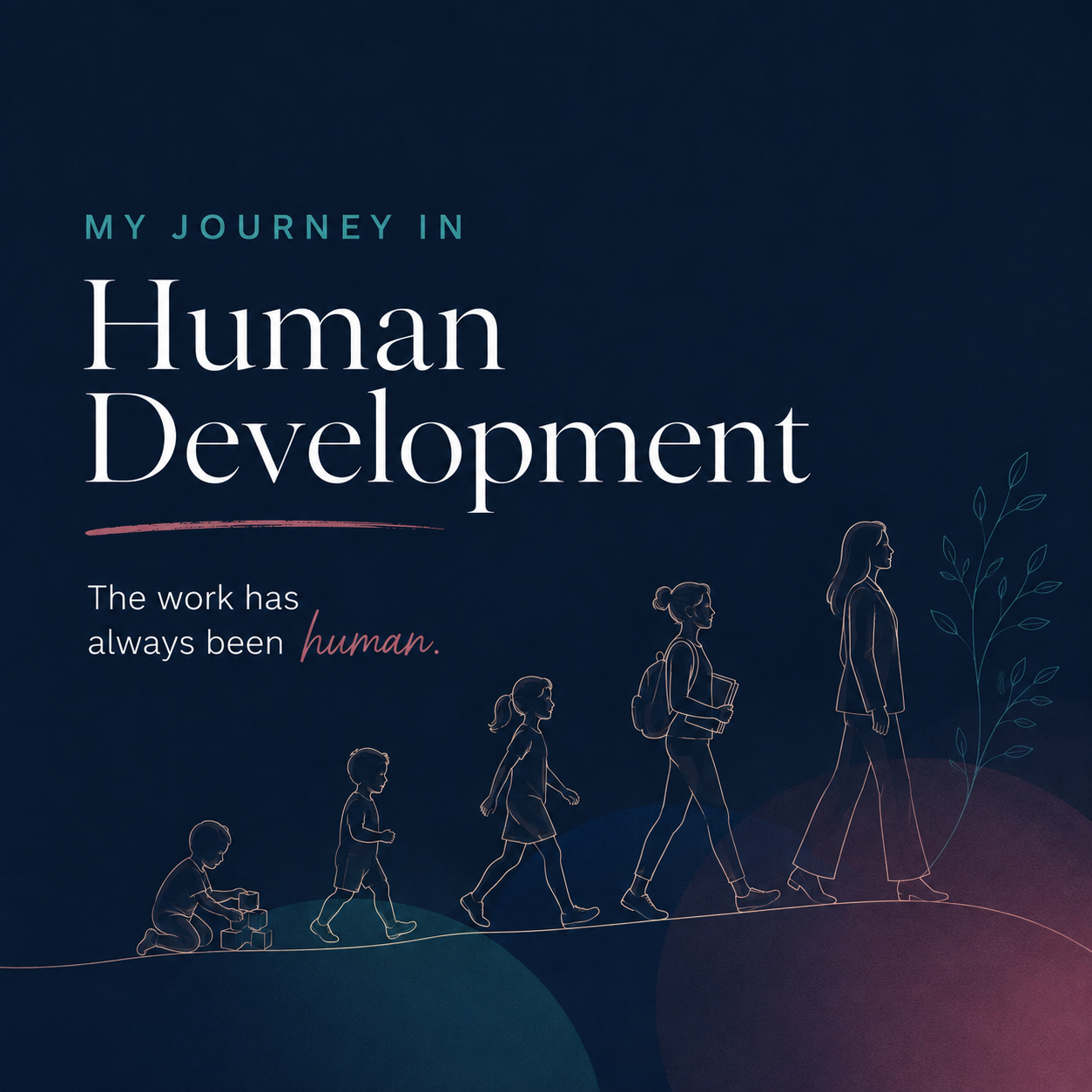
But the work has always been human.
And I am still doing what I set out to do all those years ago:
Helping humans spread their wings and fly.