When Change Ripples: A Reflection on Early Years Practice in Ontario
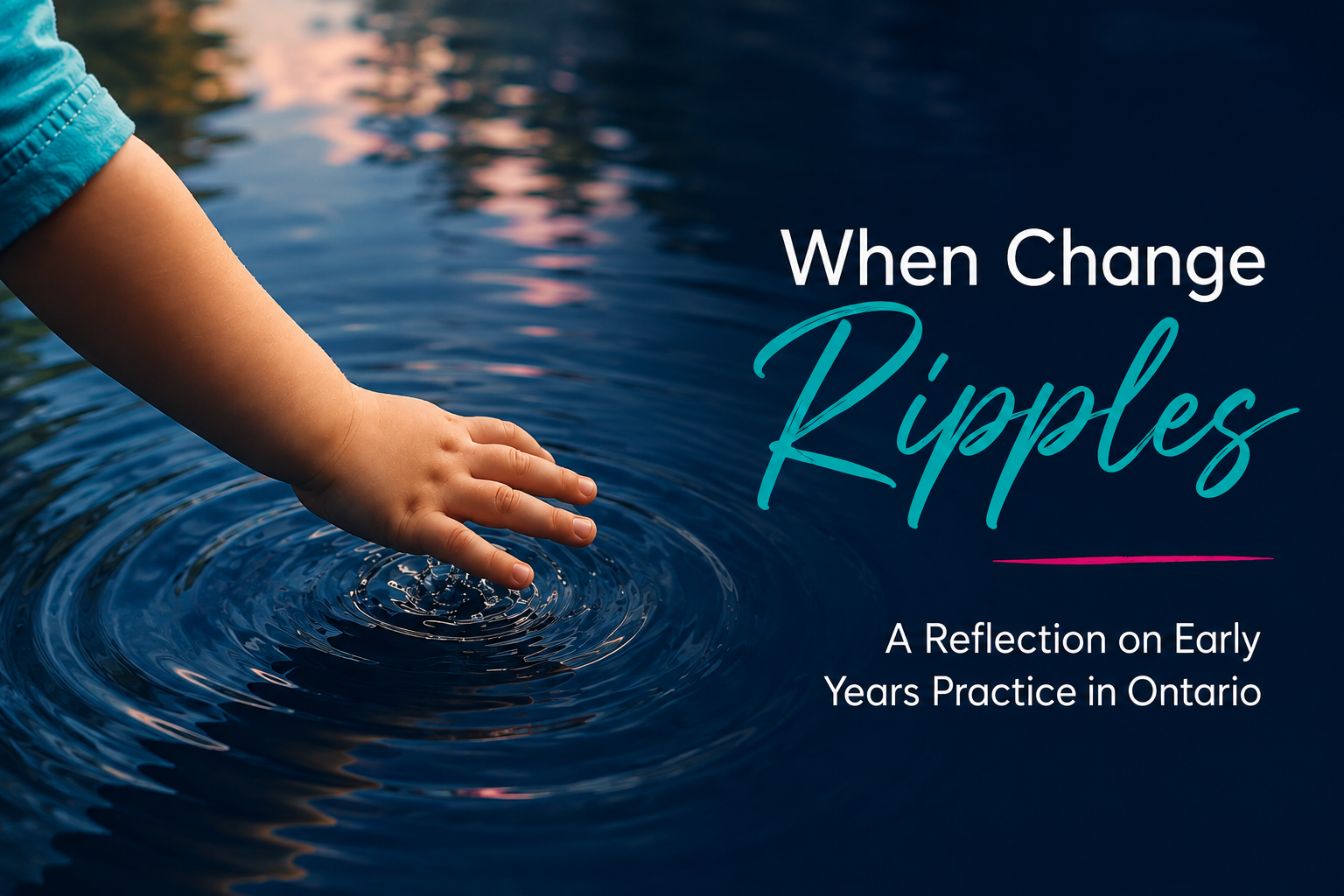
In Ontario, the revised Kindergarten curriculum introduces a stronger emphasis on explicit instruction in literacy and mathematics. The intention is clear and important—ensuring that all children have access to strong foundational skills early on.
This reflection is not about questioning that direction.
Rather, it is an opportunity to pause and consider how change within one part of the system can quietly influence others.
The Ripple Effect Across Early Years
Kindergarten does not exist in isolation. It is part of a broader early years landscape grounded in frameworks like How Does Learning Happen?, which emphasize relationships, play, and holistic development.
While the revised curriculum applies specifically to children aged four and five, shifts in expectations can shape how we think about “readiness” across the system.
This influence is often subtle.
It shows up in conversations, in planning, in the questions educators are asked, and in how families begin to understand what children need before entering school.
Rethinking Readiness
In early childhood education, readiness has never been defined by how much a child knows.
It has been defined by how a child experiences learning.
Children thrive in school when they feel confident. When they feel capable. When they see themselves as learners.
For me, the most important “ABCs” in the early years are:
Agency. Belonging. Connection.
When children have agency, they feel a sense of control and ownership in their learning.
When they experience belonging, they feel safe, valued, and ready to engage.
When they build connection, they develop the relationships that support risk-taking and growth.
These are not separate from academic success—they are the foundation of it.
Staying Grounded in Early Years Practice
For children under four, learning is rooted in:
play
movement
exploration
secure relationships
These experiences support the development of self-regulation, language, and confidence—skills that carry forward into Kindergarten and beyond.
As expectations evolve, it becomes even more important to remain grounded in what we know about child development and early years pedagogy.
Moving Forward with Mindfulness
Ontario’s early years system is strongest when its parts are aligned—but alignment does not mean sameness.
Kindergarten and child care serve different developmental stages. Their approaches should reflect that.
As a sector, this is an opportunity—not to resist change—but to be mindful of how it is interpreted and applied across contexts.
To ensure that as we strengthen outcomes, we continue to protect the environments and experiences that allow children to truly thrive.
Because when children feel confident, connected, and capable, learning follows.